
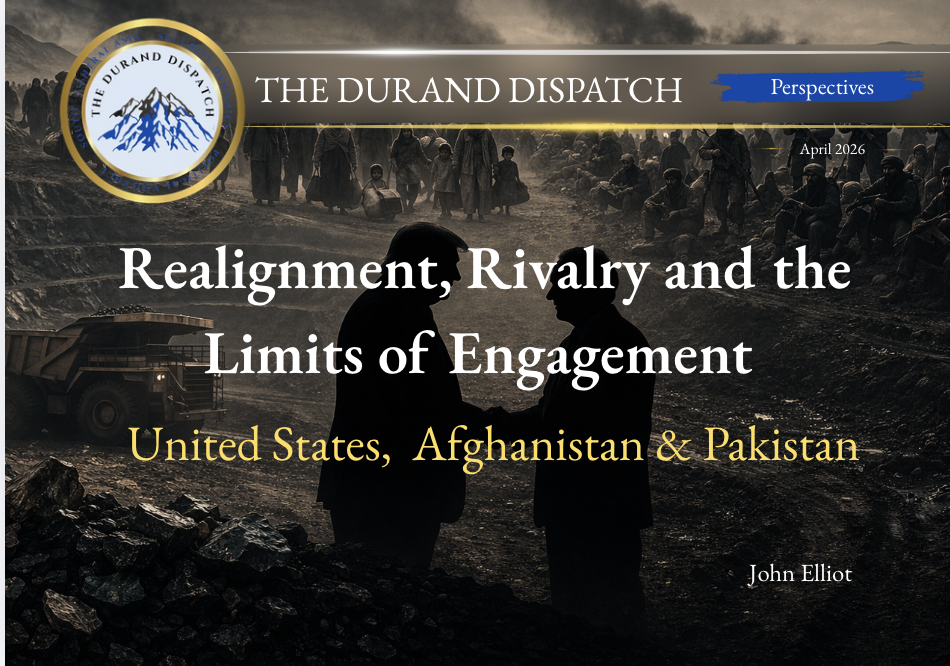
The United States’ relationships with Afghanistan and Pakistan has undergone a period of both divergence and recalibration, dynamics that would prove consequential when U.S. and Israeli strikes on Iran transformed the region overnight in February and March 2026. Washington’s posture toward Taliban-governed Afghanistan hardened markedly, driven by a convergence of security incidents, legislative action, and sweeping immigration restrictions, while its engagement with Pakistan deepened around a transactional axis of critical minerals, counterterrorism cooperation, and strategic competition with China. Across the Durand Line, the fragile architecture of cross-border diplomacy continued to buckle under the weight of militancy, mass displacement, and competing threat narratives. These bilateral adjustments shaped the positions from which both Islamabad and Kabul approached a regional crisis neither had anticipated. This article examines those interlocking dynamics across four dimensions: the deterioration of U.S.–Afghanistan relations; the deepening of U.S.–Pakistan economic and security ties; the escalation of Afghanistan–Pakistan border tensions; and the refugee and humanitarian consequences that cut across all three relationships.
U.S.–Afghanistan Relations: From Conditional Engagement to Effective Disengagement
The trajectory of U.S.–Afghanistan relations over this period was defined by a rapid narrowing of engagement channels and a turn toward containment rather than conditional dialogue. This shift reflected deeper structural factors, including the failure of two decades of reconstruction, mounting domestic scepticism about Afghan resettlement, and the Taliban’s continued refusal to meet international benchmarks on governance and women’s rights.
Subscribe to read this Perspectives article
Create an account and subscribe to read the full piece, plus access the complete archive.
Already a subscriber? Sign in