
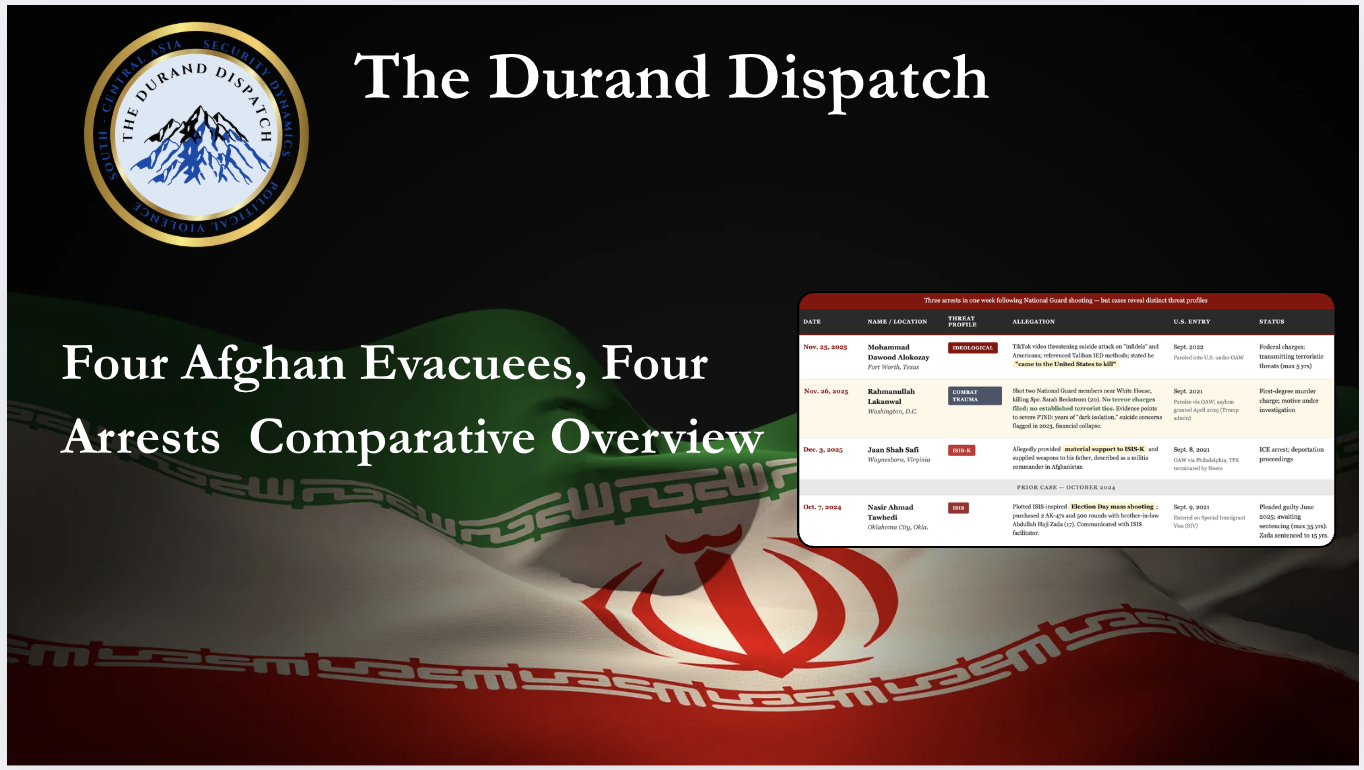
In the ten days following the fatal shooting of a National Guard soldier near the White House, the Trump administration arrested two additional Afghan evacuees on terrorism-related charges, suspended all Afghan immigration processing, and characterized the cases as evidence of systemic vetting failures under the Biden administration. This framing, however, obscures a critical analytical distinction: the shooter at the center of the policy response — a former CIA-backed commando who served eight years in elite counterterrorism units — has no established connection to a terrorist organization. Investigators have filed no terrorism charges. The available evidence instead suggests years of untreated combat trauma that existing support systems failed to address.
While other recent cases of non-state actor violence involving citizens of Afghanistan appear to conform to established patterns of ideological radicalization: explicit allegiance to jihadist organizations, consumption of extremist propaganda, and stated intent to commit violence against perceived enemies of Islam, the Lakanwal case presents a fundamentally different profile — one defined not by ideology but by psychological collapse. Emails obtained by the Associated Press reveal that community advocates had documented his deterioration for years: extended periods of isolation in darkened rooms, an inability to care for his children, erratic cross-country drives. A refugee services organization was contacted in 2023 over concerns that he had become suicidal. Yet no intervention materialized. He passed multiple layers of security vetting across two administrations — his asylum was granted in April 2025 under the Trump administration — but received no adequate mental health support. A 2023 Office of Refugee Resettlement survey found that over half of Afghan evacuees reported mental health challenges; three-quarters had not received professional assistance.
The conflation of these analytically distinct cases carries important policy implications for Afghans. The administration’s response, announced on Truth Social as a “permanent pause” on immigration from “Third World Countries”, affects thousands of individuals awaiting resettlement, many of whom remain stranded in Pakistan under conditions of considerable precarity, facing both Taliban retribution and Pakistani deportation campaigns. Obaidullah Baheer, who teaches political science at the American University of Afghanistan, characterized the policy as “collective punishment.”
Subscribe to read this Perspectives article
Create an account and subscribe to read the full piece, plus access the complete archive.
Already a subscriber? Sign in