
Editor’s Note
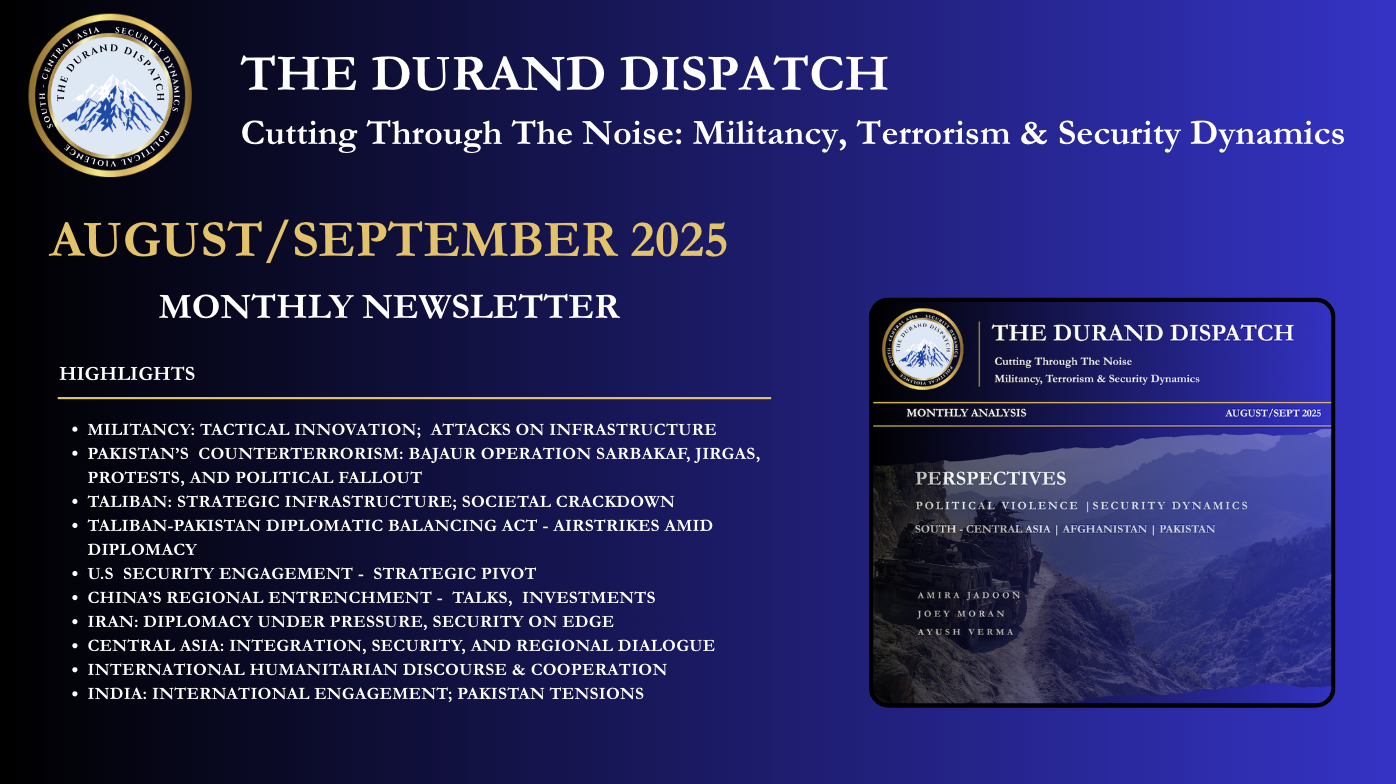
Welcome to Durand Dispatch: Perspectives, our monthly newsletter offering insights into security and militancy trends across South and Central Asia—with a special focus on the Afghanistan-Pakistan region. Brought to you by a team of academics, security professionals, local journalists, and student researchers, this Dispatch brings you timely analysis informed by open-source intelligence, ground reporting, and expert insight.
Key developments in August underscored how traditional security paradigms are being reshaped by a convergence of climate vulnerabilities, technological adaptation by militant groups, and shifting great power competition. The intersection of natural disasters with ongoing militancy in the Afghanistan-Pakistan region further highlights the importance of governance capabilities for stability, beyond conventional counterterrorism. In terms of geopolitics, Washington executed a strategic reversal, moving away from its traditional partnership with India toward Pakistan through expanded energy deals, punitive tariffs on New Delhi, and the designation of the Baloch Liberation Army (BLA) as a Foreign Terrorist Organization. China deepened its trilateral integration strategy with Pakistan and Afghanistan, while positioning Central Asian states as key transit nodes. India, meanwhile, pursued strategic autonomy by balancing a long-delayed China visit with sustained Russian energy ties and engagement in the Shanghai Cooperation Organization. On the ground, Pakistan’s airstrikes into Afghan territory and the Taliban’s reaction highlighted the persistence of cross-border frictions over militant sanctuaries, while civil unrest inside Pakistan—from Baloch Yakjehti Committee (BYC) sit-ins to jirga-led negotiations with militant factions—exposed widening gaps between federal militarization and grassroots peace initiatives. Taken together, these dynamics reveal that regional stability now hinges less on kinetic capacity alone and more on governance resilience, inclusive dialogue, and the ability of major powers to reconcile overlapping stabilization strategies.
Subscribe to read this Perspectives article
Create an account and subscribe to read the full piece, plus access the complete archive.
Already a subscriber? Sign in