
Faryal Khan is a doctoral researcher at the University of Bonn, and a Fellow at the Bonn International Center for Conflict Studies, Germany. Her research investigates the diffusion of violent ideologies and the governance practices of non-state armed groups in the Pakistan-Afghanistan borderland, with a focus on transnational militancy and ideological contestation.
This article examines how the Pashtun Tahaffuz Movement (PTM) mobilizes perception as a political force in Pakistan’s borderlands. Drawing on fieldwork conducted at the 2024 Pashtun Qaumi Jirga, it analyzes the contested interplay between PTM, the state, and militant actors, all vying to shape public imagination. The piece argues that perception—not just narrative— has become a strategic battleground where symbolic performance, selective silences, and counter-narratives interact. While PTM elevates Pashtun grievances and identity, its rhetorical ambiguity, especially regarding militancy and gender, risks undermining its transformative promise. Simultaneously, the state’s attempts to delegitimize PTM by equating it with secessionism or militancy further polarize the discourse. In this article, the author argues that both the romanticization of Pashtunistan and the securitization of dissent reflect a deeper failure to address the structural exclusions of the region. By foregrounding perception, the analysis reframes Pashtun resistance not as separatism, but as a complex negotiation of identity, legitimacy, and statehood.
Pashtun Borderlands and the Politics of Perception
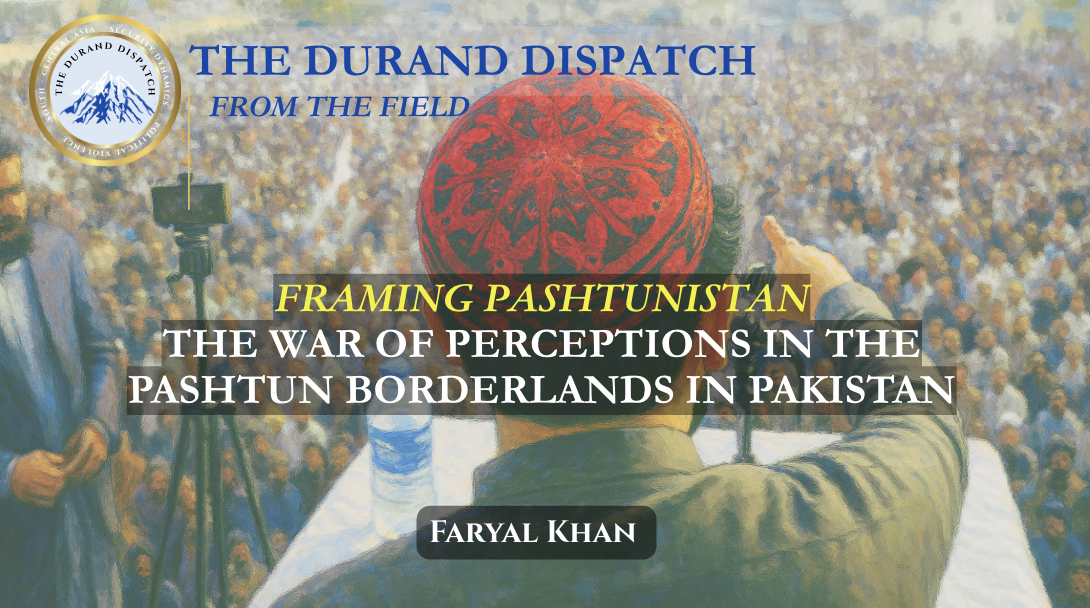
From October 11th-13th, 2024, thousands of Pashtuns—the second largest ethnic group in Pakistan—converged in Jamrud in District Khyber, one of the merged districts in the northwestern border of Pakistan with Afghanistan. The gathering was dubbed as the ‘Pashtun Qaumi (National) Jirga’ or the Pashtun Adalat (Court) which was organized by the Pashtun Tahaffuz (Protection) Movement (PTM), a grassroots human rights movement advocating for Pashtuns since its formation in 2018. The Pashtun Qaumi Jirga was called in the aftermath of the tragic killing of the poet-activist, Gilaman Wazir—a staunch critic of the Pakistani Armed forces and dedicated supporter of the Afghan people and the Islamic Republic of Afghanistan (not to be confused with the Islamic Emirate of Afghanistan).
Create a free account to read this
Sign up for a free account to read this and browse the full archive. It only takes a moment.
Already have an account? Sign in