
In June 2025, tensions between Iran and Israel sharply escalated after Israeli airstrikes on Iranian military targets prompted retaliatory missile attacks from Iran. This confrontation triggered widespread reactions across South Asia, with militant groups shaping narratives along ideological and sectarian lines.
Tehrik-i-Taliban Pakistan (TTP) cautiously supported Iran’s retaliation, while Iran-aligned Lashkar-e-Zainabiyoun openly backed Tehran, framing the conflict as a battle between “oppressors” and “defenders of Islam.” Conversely, Islamic State Khorasan Province (ISKP) and Al-Qaeda in the Indian Subcontinent (AQIS) criticized both states, portraying the conflict as a distraction from broader Muslim unity and denouncing Shia groups using derogatory sectarian rhetoric. Baloch groups largely remained silent, focusing on local insurgent priorities.
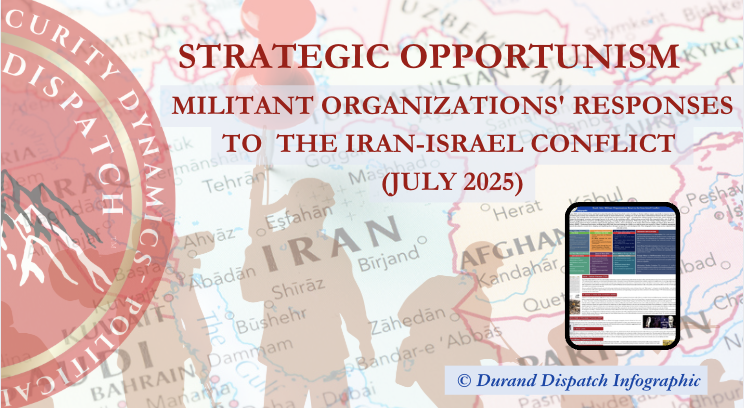
The new Durand Dispatch infographic (download below) maps these diverse responses, highlighting how propaganda narratives, sectarian divides, and strategic silence shape militant posturing in the region. It also examines broader implications, including the vulnerability of sectarian polarization, Iran’s proxy strategies, and the growing role of decentralized propaganda networks.
Create a free account to read this
Sign up for a free account to read this and browse the full archive. It only takes a moment.
Already have an account? Sign in