
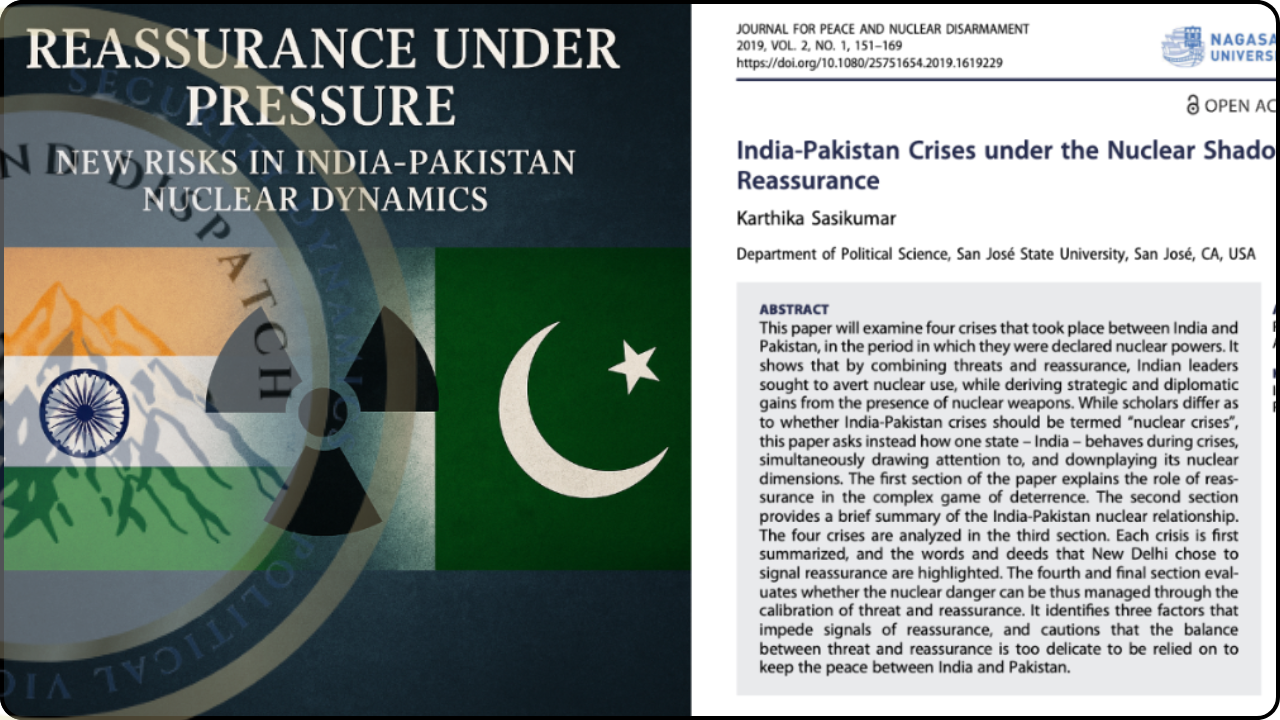
In a region where strategic competition increasingly plays out beneath the nuclear umbrella, South Asia presents one of the world’s most precarious security environments. The nuclear deterrence relationship between India and Pakistan operates through a complex paradox: while nuclear weapons have prevented full-scale war, they have simultaneously enabled more frequent low-intensity conflicts—what scholars call the stability-instability paradox. As tensions once again escalate in Kashmir following a deadly terrorist attack, insights from academic research on crisis management between nuclear powers take on renewed urgency. Karthika Sasikumar’s article “India-Pakistan Crises under the Nuclear Shadow: The Role of Reassurance,” published in the Journal for Peace and Nuclear Disarmament, provides a theoretical framework that illuminates the dangerous scenario unfolding today. Sasikumar, a political scientist at San José State University, examines four post-1998 crises between the nuclear-armed neighbors, highlighting how Indian leaders navigated a delicate balance between deterrent threats and reassurance signals to prevent escalation to nuclear use. Sasikumar argues that while nuclear deterrence relies on credible threats of retaliation, equally important are signals of reassurance that help adversaries avoid overreaction and unnecessary escalation.
The Current Crisis in Context
The attack in Pahalgam on April 22, which claimed the lives of 26 tourists, has precipitated one of the most serious crises between India and Pakistan since their 2019 military standoff. In the aftermath, India has suspended the Indus Waters Treaty and closed its airspace to Pakistani airlines, while Pakistan warned of an imminent Indian military strike and mobilized its armed forces. Both nuclear powers have exchanged gunfire along the Line of Control for six consecutive nights.
On May 6-7, 2025, India launched “Operation Sindoor,” striking nine sites in Pakistan with missiles that targeted what India described as “terrorist infrastructure,” resulting in at least three civilian casualties according to Pakistani authorities. In retaliation, Pakistan claimed to have downed five Indian fighter jets.
Create a free account to read this
Sign up for a free account to read this and browse the full archive. It only takes a moment.
Already have an account? Sign in