
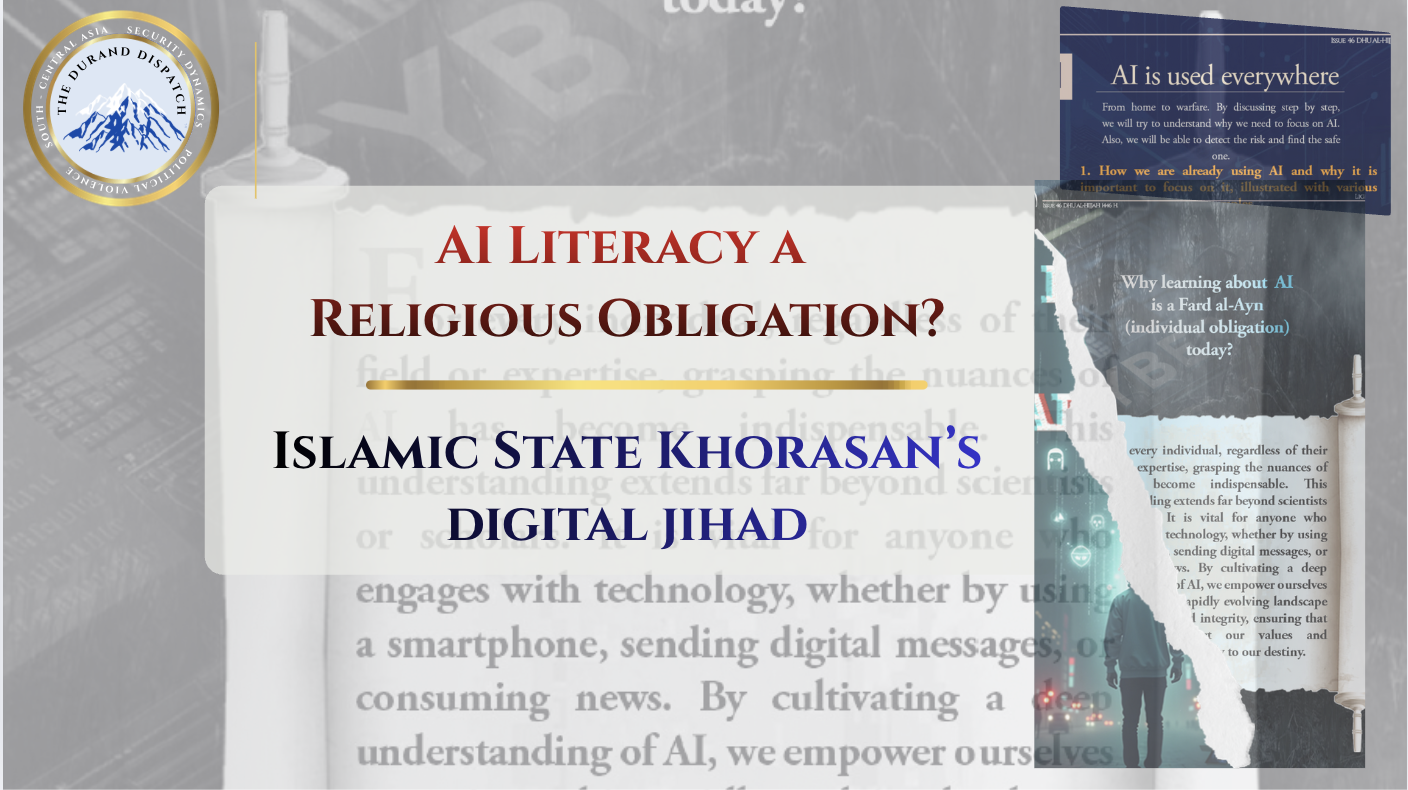
In its 46th issue, published in June 2025, the Islamic State Khorasan Province (ISKP)’s English-language magazine Voice of Khurasan introduced a notable theological innovation: declaring artificial intelligence literacy fard al-ayn—an individual religious obligation incumbent upon every Muslim. Published by ISKP’s Al-Azaim Foundation, a media apparatus that has demonstrated multilingual capabilities and increasingly employed AI in its propaganda operations since early 2024, this directive represents an evolution in violent extremist adaptation to emerging technologies. This article analyzes ISKP’s articulation of AI as religious duty, examining the theological arguments deployed, the operational security guidance provided, and the strategic implications for counterterrorism. The analysis reveals how ISKP leverages legitimate privacy concerns, documented technological vulnerabilities, and geopolitical grievances to position itself as both protector and educator of Muslim communities navigating an AI-saturated information environment. Understanding how organizations like ISKP conceptualize, communicate about, and operationalize AI literacy provides insights into the future of terrorism and the evolving requirements for effective counterterrorism.
The intersection of terrorism and technology, from early adoption of encrypted communications by violent non-state actors to social media exploitation, has long been a policy concern. Yet the June 2025 publication of Voice of Khurasan Issue 46 marks a qualitatively new development: the explicit theological elevation of artificial intelligence literacy from tactical consideration to religious imperative.