
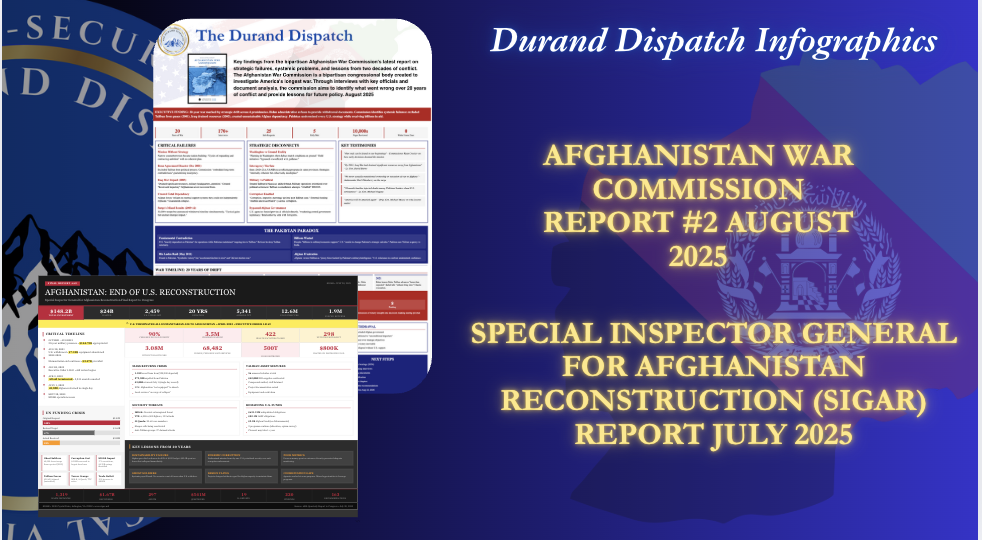
The Special Inspector General for Afghanistan Reconstruction’s (SIGAR) final quarterly report published July, 2025 and the Afghanistan War Commission’s interim report released in August 2025 offer complementary yet distinct analyses of America’s twenty-year engagement in Afghanistan from October 2001 to August 2021.
- The SIGAR published its 68th and final quarterly report to the United States Congress, as the organization ceases operations in September: this report serves as a comprehensive overview of the status of U.S. assistance to Afghanistan. The report is a final accounting of U.S. reconstruction spending in Afghanistan, documenting financial waste, tracking the 2025 termination of assistance programs, and providing oversight of ongoing contract closeouts and asset disposition, essentially fulfilling its Congressional mandate to monitor and audit the use of taxpayer funds.
- The Afghanistan War Commission (AWC) was established by the U.S. Congress in 2021 as an independent body to review U.S. decisions related to the war in Afghanistan from June 2001 to August 2021, and it is required to report on its progress annually. The AWC released its second interim report, which captures the work of the past year, including public hearings, fact-finding missions, and emerging themes that will shape the final report in August 2026. The report aims to conduct a comprehensive historical examination of strategic and operational decisions across the entire twenty-year war, synthesizing testimony from military leaders, diplomats, and Afghan officials to extract lessons for future U.S. interventions, with their final report due in August 2026.
Both reports convergence on fundamental issues. They identify systemic corruption as a primary driver of mission failure, with SIGAR quantifying at least $24 billion in wasted taxpayer funds while the Commission traces how corruption eroded public trust and government legitimacy throughout the conflict. The reports align in their assessment of Pakistan’s contradictory role, simultaneously essential for U.S. logistics yet providing sanctuary to the Taliban, as a critical impediment to success. Both reports also conclude that Afghan institutions, particularly the Afghan National Defense and Security Forces (ANDSF), were fundamentally unsustainable without continuous external support, a dependency dramatically illustrated by the government’s collapse in August 2021 following U.S. withdrawal. The persistent problem of “ghost soldiers” appears in both accounts as emblematic of deeper institutional dysfunction, and each report documents the drift from initial counterterrorism objectives toward ambitious nation-building goals without commensurate resources or coherent interagency coordination.
Where the reports diverge reflects their distinct mandates. SIGAR, maintains its focus on financial accountability and reconstruction program implementation, documenting the ongoing challenges of the 2025 aid termination under Executive Order 14169 and Taliban seizure of U.S.-funded assets, while the Commission undertakes a broader strategic assessment examining diplomatic and military decision-making across presidential administrations. The convergence of findings from two independent investigations—one focused on programmatic execution, the other on strategic design—suggests that the failures in Afghanistan represented not merely tactical or implementation challenges but rather fundamental miscalculations about the achievability of U.S. objectives that persisted throughout the intervention.
Create a free account to read this
Sign up for a free account to read this and browse the full archive. It only takes a moment.
Already have an account? Sign in