
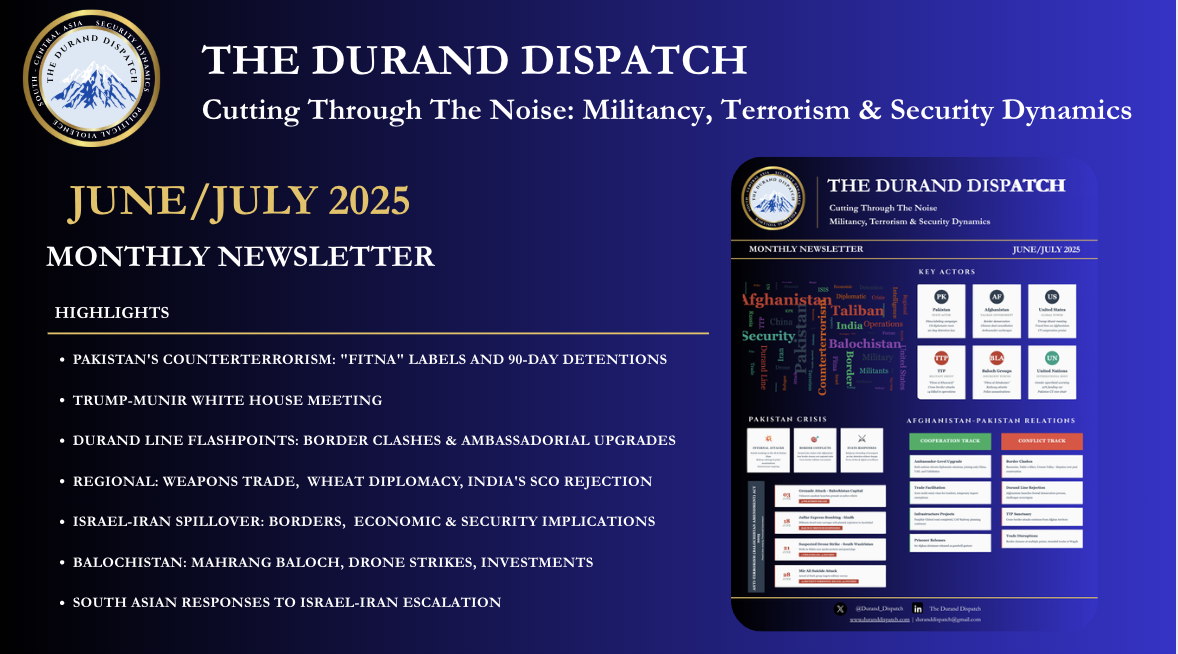
Editor’s Note
Welcome to Durand Dispatch: Perspectives, our monthly newsletter offering insights into security and militancy trends across South and Central Asia—with a special focus on the Afghanistan-Pakistan region. Produced by a team of academics, security professionals, local journalists, and student researchers, this Dispatch brings you timely analysis informed by open-source intelligence, ground reporting, and expert academic insight.
Security Deterioration and State Response Pakistan’s internal security landscape continued to be marked by militant attacks perpetrated by the Tehrik-i-Taliban Pakistan (TTP), Baloch militants, and other affiliated groups. Suicide bombings in Mir Ali and Ghulam Khan in late June, railway sabotage in Sindh, and targeted killings in Balochistan and Khyber Pakhtunkhwa underscored the evolving tactics of militant networks. In response, Pakistan continued its counterterrorism campaign with religiously-charged rhetoric, as security forces used “Fitna al Hindustan” and “Fitna al Khawarij” labels for Baloch and TTP militants respectively. This framing serves multiple purposes: portraying militancy as foreign-sponsored terrorism, rallying domestic support, and justifying expanded military operations. Additionally, the the Anti-Terrorism (Balochistan Amendment) Act 2025 was passed, legalizing 90-day detentions without charges. This securitized approach extends from suspected drone strikes in Waziristan to expanded cybercrime prosecutions, raising fundamental questions about civil liberties and state accountability.
Subscribe to read this Perspectives article
Create an account and subscribe to read the full piece, plus access the complete archive.
Already a subscriber? Sign in