
Editor’s Note
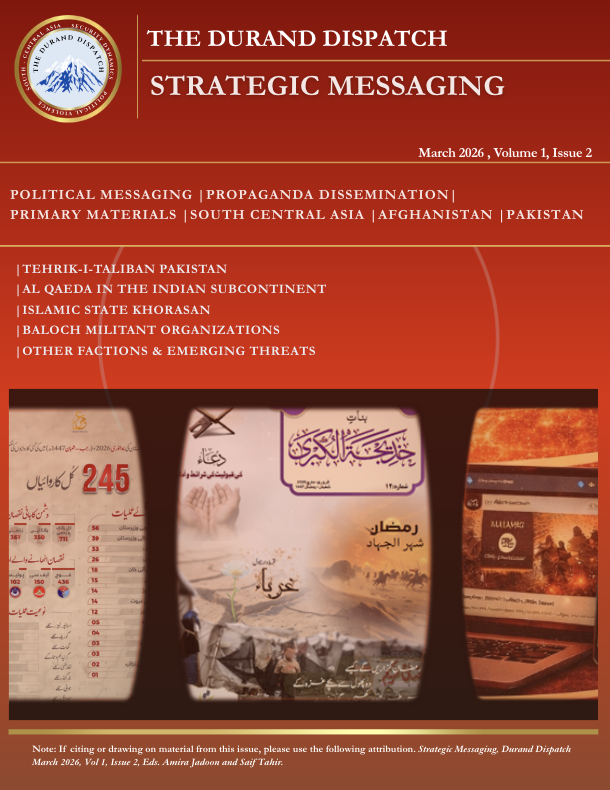
Welcome to the March 2026 issue of the Durand Dispatch: Strategic Messaging, that examines how non-state actors across the Afghanistan–Pakistan region shape perceptions, frame legitimacy, and assert influence through media and narrative construction. This analysis complements our Durand Dispatch: Perspectives Series, which covers a wider range of topics including militancy, Afghanistan-Pakistan relations, and security dynamics across South/Central Asia. Together, the two provide a fuller understanding of how strategic messaging intersects with on-the-ground dynamics.
In February 2026, Pakistan’s militant landscape was marked by converging ideological narratives, expanding operational reach, and tactical evolution across jihadist and separatist organisations. A single political development, Pakistan’s decision to join the U.S.-backed Gaza Board of Peace, served as a unifying thread across otherwise competing factions, shaping propaganda output from the Tehrik-i-Taliban Pakistan (TTP) to Al-Qaeda in the Indian Subcontinent (AQIS) to Baloch separatist groups in ways that warrant close attention.
This issue documents tactical shifts that suggest several organisations are professionalising faster than perhaps publicly acknowledged, geographic expansions into theatres with limited prior militant presence, and early signals of convergence between jihadist and separatist networks that could reshape the security landscape in Balochistan and beyond.
Subscribe to read this Strategic Messaging article
Create an account and subscribe to read the full piece, plus access the complete archive.
Already a subscriber? Sign in