
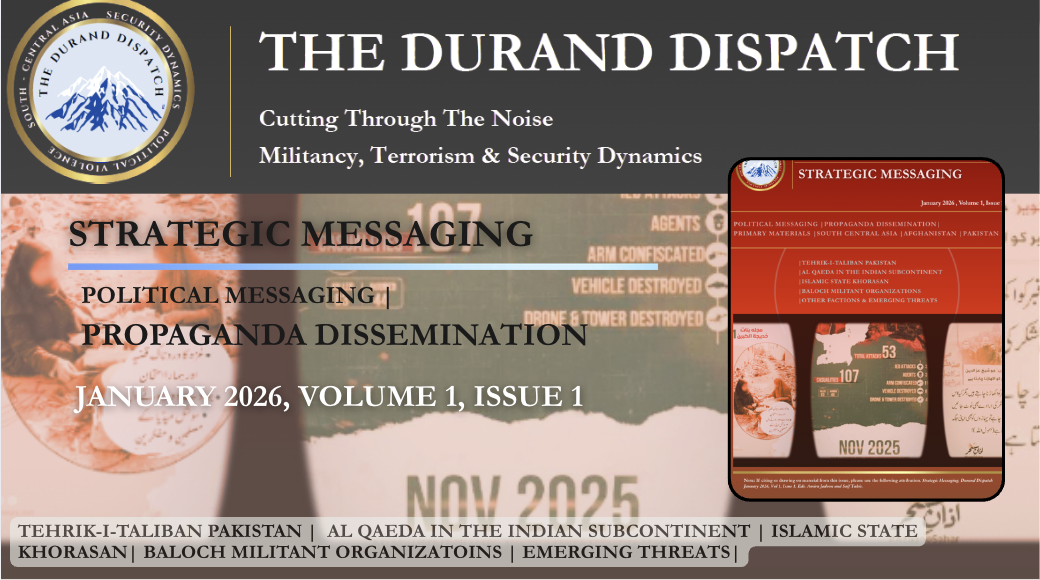
Editor’s Note
Welcome to the January 2026 issue of the Durand Dispatch: Strategic Messaging, our monthly publication that examines how non-state actors across the Afghanistan–Pakistan region shape perceptions, frame legitimacy, and assert influence through media and narrative construction. This analysis complements our Durand Dispatch: Perspectives Series, which covers a wider range of topics including militancy, Afghanistan-Pakistan relations, and security dynamics across South/Central Asia. Together, the two provide a fuller understanding of how strategic messaging intersects with on-the-ground dynamics.
The closing months of 2025 revealed a militant landscape that is diffuse, adaptive, and increasingly difficult to contain. In November–December, the Tehrik-i-Taliban Pakistan (TTP) continued pushing beyond its Pashtun heartlands into Gilgit-Baltistan, rural Sindh, South Punjab, and Balochistan, demonstrating a willingness to operate inside ethnic, sectarian, and political fault lines the state has historically struggled to manage. At the same time, counterterrorism pressure produced meaningful disruptions—most notably the December disclosure that Islamic State Khorasan Province (ISKP) chief spokesperson and Al-Azaim founder Sultan Aziz Azzam had been arrested in May—yet propaganda adaptation and tactical learning continued across the ecosystem.
This issue of Durand Dispatch maps what matters for 2026: where the violence is diffusing, which factions are fragmenting or aligning, and what new operational capabilities are becoming normalized—including thermal-enabled sniper warfare tied to U.S. weaponry left behind in Afghanistan, evolving suicide-attack dynamics, and the growing use of female bomber symbolism in Baloch mobilization narratives.
Subscribe to read this Strategic Messaging article
Create an account and subscribe to read the full piece, plus access the complete archive.
Already a subscriber? Sign in