
Key Insights
- The issue’s nine articles are sequenced to build a single argument. They define who counts as a mujahid, rule out nationalist and tribal fighting as jahiliyya (pre-Islamic ignorance), and accuse the Afghan Taliban of apostasy through its foreign alliances. They then declare jihad against Pakistan an individual obligation on doctrinal rather than nationalist grounds, and tell the reader where legitimate authority lies and how to die for it.
- Anti-nationalism is the hinge. The opening article rejects fighting for “nation, homeland, tribe, or organization.” That single move disqualifies the Afghan Taliban, the TTP’s Pashtun-nationalist framing and the Baloch separatists at once. It is ISKP’s sharpest point of contrast with every rival in the region and the argument it has used to poach TTP fighters.
- The Taliban polemic is specific and reactive. Article 4 rebuts four named Taliban accusations: that the Islamic State is an American project, a Pakistani agent, an Pakistani Inter-Services Intelligence (ISI) collaborator and an ally of anti-Taliban militias in Balochistan. It names Abbas Stanikzai, dates Taliban–US contact to 2007, and cites ISKP’s own recent killings as proof.
- The external-attack content is the most threat-relevant material, but it should be read with care. Posters placed between doctrinal articles urge strikes on “the heart of America,” name soft targets (processions, stadiums, gatherings), endorse knives and vehicles, and prescribe a calendar-based method for timing attacks to Western festivals. However, the World Cup poster was released after the tournament had ended, which suggests some of this material was prepared earlier and published late. A back-page teaser announces a continuing series on “overthrowing Western culture and political systems.”
- The issue reflects a group under pressure. It appeared after a year of arrests and takedowns that left ISKP’s official media largely dormant. Its bilingual construction (Pashto for local polemic, Arabic for doctrinal authority) and AI-generated imagery are consistent with a media wing rebuilding with reduced capacity but an unchanged line.
- A ninth article promotes “jihad with wealth.” It argues that financial contribution can at times take precedence over self-sacrifice, because jihad cannot be waged without resources, and urges supporters to give from their material wealth. This foreshadows the fundraising drive that pro-ISKP outlets ran in September and October.
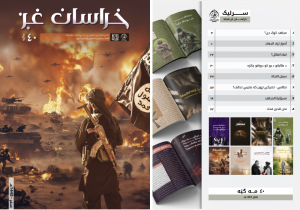
Khorasan Ghag, Issue 40 front cover and contents page – Al-Azaim Media
Background: A Media Wing in Recovery
Islamic State Khorasan Province (ISKP) emerged in 2015 as Islamic State’s official affiliate for Afghanistan and Pakistan. It drew its first recruits from disaffected factions of the Pakistani and Afghan Taliban and from former al-Qaeda operatives. From the outset it has built its brand by rejecting accommodation. It treated the Afghan Taliban as apostates for negotiating with the United States, and later for engaging with other international actors. It cast the TTP as a nationalist “replica” of the Taliban, Pakistan’s state and military as taghut, and Shia communities as polytheists to be targeted. Its propaganda apparatus, led by the Al-Azaim Foundation, has been multilingual from the start: Voice of Khurasan in English, Nida-e-Khurasan and Yalghar in Urdu, and Khorasan Ghag in Pashto.
The past few years have been some of the hardest in ISKP’s media history. European takedowns of pro-IS hubs in 2024 and platform-wide account closures through 2025 cut its reach. Pakistani authorities arrested Sultan Aziz Azzam, Al-Azaim’s founder and ISKP’s chief spokesman, on May 16, 2025. Other senior media figures were also detained. Together, these losses reduced official output to translated Al-Naba material under successive banners (Nashir Pakistan and Nida-e-Haq). A Khorasan Ghag issue released in mid-2025 had itself been delayed by what the group called operational problems. By mid-2026, official channels were largely dormant and locally run accounts were recycling old lectures.
Create a free account to read this
Sign up for a free account to read this and browse the full archive. It only takes a moment.
Already have an account? Sign in